

Exploring New Reefs with Drop Cameras: Hidden Oases off Georgia's Coast
By Rachel Plunkett and Danielle Oxman
September 16, 2025
Did you know there's an oasis of life off the coast of Georgia? Gray's Reef National Marine Sanctuary is one of the largest nearshore live-bottom reefs of the Southeastern United States. Within its 22 square miles, natural ledges and rocky outcrops create a thriving underwater community of sponges, corals, fish, and sea turtles.
Now, researchers are asking a big question: are there other hidden habitats like this just beyond the sanctuary's borders? To find out, scientists are turning to versatile equipment known as drop cameras, which allow them to explore places too deep, too rough, or too remote to safely dive.
Eyes on the Seafloor: What's a Drop Camera?
A drop camera is a simple but powerful tool: a video camera housed in a weighted frame, lowered over the side of a vessel to record what lies beneath. The camera streams a live video feed to researchers on deck, who can monitor conditions in real time while the footage is also stored for later analysis.


Drop cameras don't require a pilot to navigate, unlike remotely operated vehicles (ROVs). Gray's Reef's scientists can deploy them to depths of up to 150 feet, and because they aren't limited by bottom time or safety concerns like scuba divers, the cameras can record longer and more safely. This makes them ideal for reconnaissance: a quick way to see if a site is worth deeper study.
Alison Soss, the sanctuary's geospatial analyst and research program specialist says that "Drop cameras are a relatively simple yet powerful tool for ocean exploration. They allow us to quickly capture valuable imagery of seafloor habitats, and, with minimal equipment, we can bring the seafloor to the surface—engaging students, stakeholders, and the public in the wonder of marine discovery."
Unlocking Secrets Beneath the Waves
The main mission is to search for other live-bottom habitats outside the sanctuary's boundaries. These rocky ledges and hard-bottom areas are biodiversity hotspots, but many remain unmapped and unseen.
The drop camera can help reveal:
- Species observations – documenting which organisms are consistently present, and tracking seasonal changes.
- Habitat mapping – ground-truthing sonar maps by showing the actual structure and features of the seafloor.
- Data confirmation – checking whether past mapping still reflects current conditions, since currents and shifting sands can cover or expose ledges.
This work using non-invasive technology supports NOAA's broader priorities of accelerating exploration and mapping of our marine resources, monitoring fish populations, and supporting healthy coastal ecosystems that vibrant tourism and recreation industries depend on.
Trial by Winch: First Deployment on R/V Gannet
Before the drop camera can head offshore, the Gray's Reef team needed to practice deploying it from their new research vessel, R/V Gannet. While the camera had previously been used from NOAA Ship Nancy Foster, this was the first time the crew handled the operation on their own small vessel.
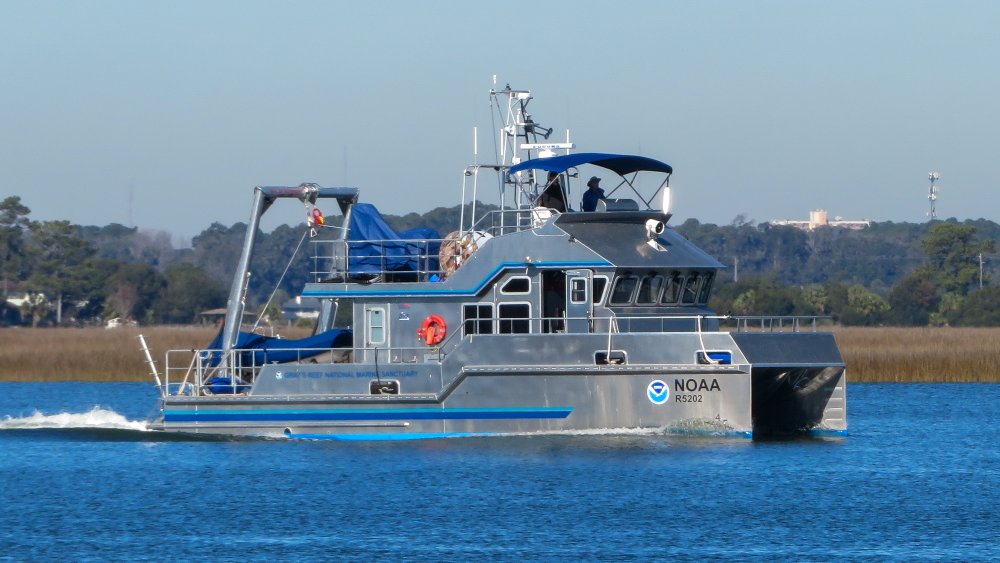
The trial began with a walk-through of the vessel's hydraulic system, threading cables through the pulley system, and preparing the A-frame to lower the camera. Safety checks were critical: crew discussed protective equipment and assigned roles—from winch operator to cable manager to the officer-in-charge on the bridge.
According to Lieutenant Junior Grade Christy Starsinic, the sanctuary's vessel operations coordinator, maneuvering the hydraulic winches for the first time came with some challenges.
"Preparing cables was more complex than expected, and keeping the camera steady required careful coordination among crew," says Starsinic. "Lessons learned from this trial will serve as a basis for developing the skills and experience that will allow us to smoothly execute winch operations aboard R/V Gannet for long into the future."
Despite the hurdles, the team drafted safe operating procedures and gained valuable experience for the next mission.
From Science to Storytelling
The drop camera isn't just a research tool—it's also a bridge between science and the public.
For ongoing projects, it helps fill data gaps when diving isn't possible, contributing to fish population monitoring and benthic habitat studies. For outreach, it creates opportunities to "bring the reef to the people." Visitors at the Gray's Reef Ocean Discovery Center or viewers online will eventually be able to watch the same video that scientists are using to study the ocean.
The team also hopes to share footage with partner institutions, enabling other researchers to use the data for their own projects.

Charting the Next Frontier
Looking ahead, Gray's Reef researchers plan to refine their deployment procedures and expand drop camera surveys farther offshore.
"One of the most exciting upgrades is the addition of lasers for photogrammetry, which will allow us to calculate distances and sizes in the video footage," Soss adds.
This means more precise measurements of fish populations, habitat dimensions, and species density.

These efforts will help answer long-standing questions about Georgia's offshore ecosystems—and may reveal new habitats as rich and vibrant as Gray's Reef itself. By combining innovative technology, dedicated crew training, and a commitment to education, scientists are expanding our understanding of the ocean just off Georgia's coast.
Whether through new data for researchers or livestreamed footage for the public, the drop camera is helping bring the wonders of Georgia's reefs closer to home.
Rachel Plunkett is the content manager and senior writer/editor for NOAA's Office of National Marine Sanctuaries
Danielle Oxman is the outreach and social media specialist for Gray's Reef National Marine Sanctuary