Ocean Guardian Kids Club School

What is it? | How to Become an Ocean Guardian School | Example Projects | Schools in the News | Resources

How to Become an Ocean Guardian School diver

  • Eligible school: Any school (K-12) located in the following California counties can become an Ocean Guardian School: Marin, San Francisco, Alameda, Contra Costa, San Mateo, Santa Cruz, Santa Clara, Monterey, San Benito, San Luis Obispo, Santa Barbara, Sonoma, and Ventura.
  • Grants range in the amounts of $2,000 - $6,000 per school depending on the level of the project and the number of classes/grades involved.
  • Grant applications are due May 1 (for projects to begin Sept 1). Projects must run for the school's full academic year.
  • Funding decisions will be made by early June.
  • Teacher stipends are also limited to 30% of total budget.
Ocean Guardian School Project Requirements
  1. SCHOOL- OR COMMUNITY-BASED PROJECT: The Ocean Guardian School program funds projects focused on current issues affecting local watersheds, ocean and/or marine sanctuaries while promoting best environmental practices. Through a school- or community-based project, schools work to make a difference in the health and protection of their local watersheds, ocean and/or marine sanctuaries. Below is a list of general topics and examples of projects that are commonly funded by the Ocean Guardian School Program. If your project idea does not relate to this list, but meets the goals of the program, please contact the program director to discuss your idea before applying. Remember to keep the proposal focused on a single project.

    • Restoration - Watershed/wetland restoration, fish habitat creation, shoreline/bank stabilization
    • Recycling/Reuse/Reduce - School-wide recycling/composting programs, redesign and implementation of school-based wastewater system, school-wide green purchasing program, zero waste lunch programs
    • Marine Debris - Program to reduce single use plastic bottles in school, promoting reusable bags in local community/stores, marking school and local storm drains
    • Water Quality Monitoring - Monitoring data used to help create or redefine a community watershed management plan, school-use water plan, or community land-use plan
    • Schoolyard Habitats/Gardens - Creating or improving school gardens/schoolyard habitats with an emphasis on native plants, low water use, rain catchment systems, etc. while clearly connecting these activities to the health and preservation of the local watershed and/or ocean.

  2. KICK-OFF EVENT: Once you have received funding, we ask that you formally inform the entire school about your Ocean Guardian School project. A school-wide assembly is recommended for this event, but other approaches are welcome. Please include the following in your assembly: description of the project, its goals, how your project contributes to the protection and/or conservation of the local watersheds and/or ocean, introductory information about national marine sanctuaries, and the commitment that the school is making to protect the watersheds, ocean and national marine sanctuaries.
  3. WRAP-UP EVENT: At the end of the project period, students who have been involved with the Ocean Guardian project will creatively present some aspect of the project to the entire student body(i.e., their experiences, lessons learned, best practices, community outreach and future plans). Presentations can take the form of videos, reading, art work, songs, plays, poems, etc.
  4. WATERSHED IDENTIFICATION: All projects must incorporate learning opportunities around watershed identification. Students should be able to identify in what watershed their school is located as well as some of the surrounding watersheds, nearby ocean and national marine sanctuaries.
  5. OCEAN LITERACY PRINCIPLES: Please visit NOAA's website to view the Ocean Literacy Principles. At least one (preferably more) Ocean Literacy Principle must be integrated into your school project.
  6. FINAL REPORT: A final project and budget report is required at the end of your project period.
  7. EVALUATION: We may ask you to participate in an Ocean Guardian School evaluation at the end of your project period. This might involve the participation of the principal, teacher(s), students, parent(s), and/or community members who have worked on the project.

First Step

  • Develop a plan of action and a budget that outlines your school- or community-based project. Remember to keep the proposal focused on a single project that contributes to the health and conservation of your local watershed(s), world's ocean and/or national marine sanctuaries.

What Your School Receives
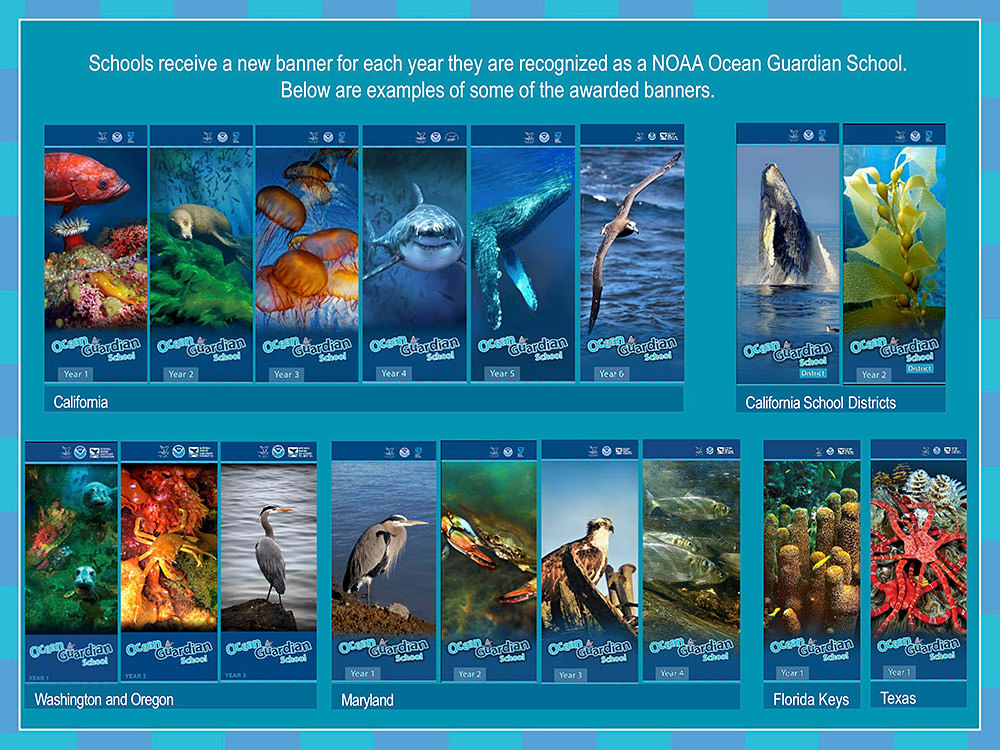
  • At the end of a funded project period, if program requirements have been met, your school will be recognized as an Ocean Guardian School and receive an official Ocean Guardian School banner.

For more information or general support, please contact Naomi Pollack.

Back to Ocean Guardian Programs Page

leaving site indicates a link leaves the site. Please view our Link Disclaimer for more information.
Revised March 16, 2011 by Sanctuaries Web Team | Contact Us | Web Site Owner: Office of National Marine Sanctuaries
National Ocean Service | National Oceanic and Atmospheric Administration | U.S. Department of Commerce | Privacy Policy | For Employees
http://sanctuaries.noaa.gov/education/ocean_guardian/become.html