Error processing SSI file
|
Acoustic Fish Tracking and Tagging
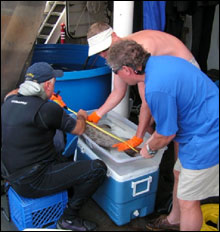 |
| Greg, Mark, and Matt measuring a scamp before tagging.
|
The purpose of the acoustic tagging project at Gray’s Reef National Marine Sanctuary is to determine the movement patterns of red snapper Lutjanus campechanus, gag grouper Mycteroperca microlepis, and scamp grouper Mycteroperca phenax within certain areas of the sanctuary. During last year’s Nancy Foster cruise, scientists tagged eight fish (one gag, one red snapper, and six scamp) and deployed four acoustic receivers which detect the tagged fish. Preliminary data has shown that all eight fish have been present and active in the reef at some point in the past year. The gag seems to be a year-round resident, who has been detected every day from May 2008 to February 2009 (data since February has not yet been processed). The red snapper and several scamp seem to come and go at different parts of the year. This year, scientists plan to tag up to 35 more fish and deploy as many as ten additional receivers.
Fish will be collected for tagging with the help of the Georgia Department of Natural Resources (GADNR). Fish will be sampled using the GADNR research vessel Marguerite and the Gray’s Reef research vessel Sam Gray. Fish will be caught using hook and line, measured, tagged externally with “spaghetti” tags, and transported to the Nancy Foster. Aboard the Nancy Foster, the fish will have an internal transmitter tag surgically implanted into their abdominal cavity. Fish will be observed until healthy habits (swimming actively and upright) are resumed. Aquarists from the Georgia Marine Extension Service will be on board the ship to help ensure that the fish are handled carefully and will be returned to the sanctuary in good health. The fish will be released at the same site where they were captured. The implanted transmitters will last for roughly two years before the battery dies.
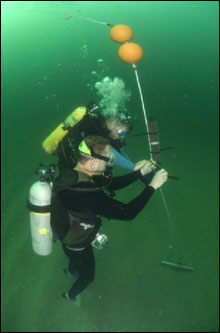 |
| Mark Monaco and Matt Kendall deploying an acoustic receiver. (Photo: Greg McFall)
|
The second objective is to deploy up to ten acoustic receivers. The transmitters emit a signal every two minutes. This signal is detected by any receiver within range of that signal. Receivers will be placed in areas close to where the fish were caught and will be suspended in the water column approximately 1.5 meters from the bottom. The position in the water column is important because the hydrophone that detects the signals is on the top of the receiver. If the fish are directly below the receiver hydrophone there is a chance the fish will not be detected. The receivers have a usual detection range of about 200 meters. Downloading this information from the receivers requires divers to recover the receivers from the buoy lines they are attached to and bring the receivers to the surface. On the surface, crew cleans and dries the receivers, then plugs a Bluetooth © adapter into the receiver. This allows the receiver to communicate, wirelessly, with the laptops on board the ship. After the information is downloaded, divers return the receivers to the buoy lines, where they can listen and record more transmitters.
Gray's Reef National Marine Sanctuary is currently considering setting aside
a portion of the sanctuary to serve as a research area. An area that is
available primarily for research in the Sanctuary will provide scientists
with a control area useful for the comparison of natural processes with
human-induced change at GRNMS. The tagging project will enable scientists to
gather valuable baseline data on fish movement and help to determine how
long tagged fishes stay in the sanctuary. Data from this project will be
crucial in determining if there is an adequate level of resource protection
being provided for the fishes which make the habitats of Gray's Reef their
home.
|








 indicates a link leaves the site. Please view our