Error processing SSI file
Introduction
 | | (Photo: A. Lombardi) |
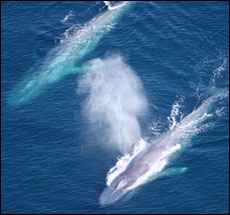
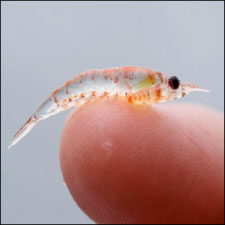
West coast national marine sanctuaries are host to numerous threatened and endangered whale species such as blue, humpback, and fin whales among others. Their status can be seen on the IUCN website. These migratory whales rely on the highly productive waters located in the west coast sanctuaries supplied by the California Current System.
 | | (Photo: Sophie Webb/PRBO/NOAA-ONMS) |
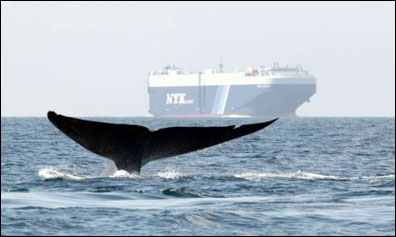
The ports of Los Angeles and Long Beach, San Diego, San Francisco Bay Area, Portland, and Seattle together service more than 50% of all container ship traffic coming to and from the United States. In order to access the ports these large ships routinely travel through west coast sanctuaries. The combination of high traffic, feeding areas, and migratory whale routes result in a marked increase risk of ship strikes to whales that can result in serious injury or death to whales.
 | | (Photo: J. Calambokidis/Cascadia Research) |
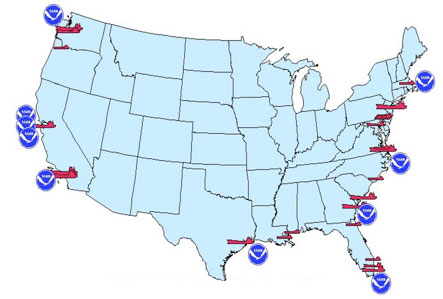 | | National Marine Sanctuary sites and the top 25 US container ship ports. Data from the US Department of Transportation, 2004 (Credit: G. Galasso) |
In the fall of 2007, four blue whales were struck and killed by ships and found in or near the Santa Barbara Channel and Channel Islands National Marine Sanctuary. Three years later, between July and October 2010, two blue whales (one pregnant female that resulted in the loss of the fetus), one humpback, and two fin whales were found dead in and around Monterey Bay, Gulf of the Farallones, and Cordell Bank National Marine Sanctuaries. Accordingly, mortality from ship strikes has been identified as a threat to population recovery of these vulnerable whale species. Their distribution often coincides with ship traffic and in certain areas also overlaps with shipping traffic lanes. Large whales are vulnerable to collisions with all vessel types, sizes, and classes throughout the world's oceans. In California, ship strikes of gray whales are the most commonly reported followed by fin, blue, humpback, and sperm whales. When large vessels such as container ships are involved, the ships crew may be unaware a strike has occurred. As such, the number of ship strikes to whales is likely under reported. Between 1988 and 2012, there were 100 documented large whale ship strikes along the California coast.
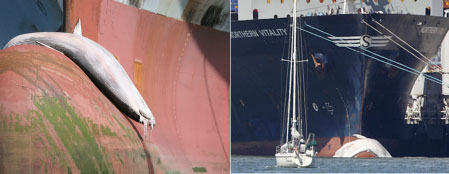 | | (Photos: (left): A. Schulman-Janiger (right): P. Chinn/The Chronicle) |
Herein you will find information on the West Coast Region's efforts to manage, monitor, and research the ship strike issue, as well as educate and involve local communities. Ultimately, west coast sanctuaries and their partners aim to protect large whales with these ongoing initiatives.
Learn about shipping lane changes to protect whales and increase mariner safety in the San Francisco Bay area and the Santa Barbara Channel that was made possible by the collaboration among National Marine Fisheries Service, US Coast Guard, industry and sanctuaries, under "Policy and Management."
To hear from Sean Hastings, the Resource Protection Coordinator at Channel Islands National Marine Sanctuary, listen to the West Coast Ship Strikes podcast. To hear from Michael Carver, the Deputy Superintendent of Cordell Bank National Marine Sanctuary, listen to the Reducing the Threat of Ship Strikes to Whales podcast
produced by Thank You Ocean. Click here for a captioned version of this video. For an update on a voluntary incentive program, by Sean Herron, former Sea Grant Fellow, watch the Slowing Ships for Cleaner Air, Safer Whales podcast.
podcast. To hear from Michael Carver, the Deputy Superintendent of Cordell Bank National Marine Sanctuary, listen to the Reducing the Threat of Ship Strikes to Whales podcast
produced by Thank You Ocean. Click here for a captioned version of this video. For an update on a voluntary incentive program, by Sean Herron, former Sea Grant Fellow, watch the Slowing Ships for Cleaner Air, Safer Whales podcast.
|








